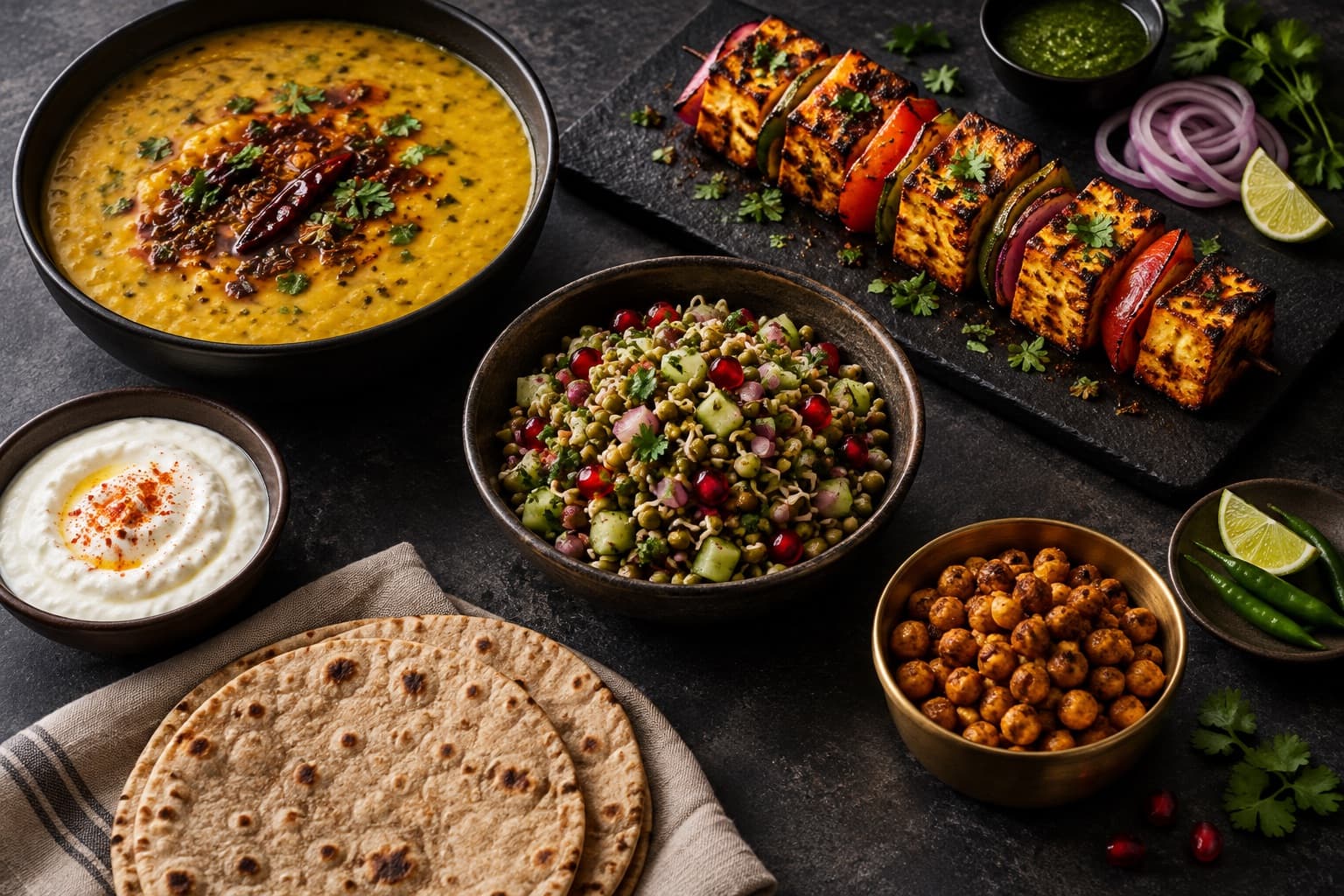
Protein advice swings between two bad extremes: the gym-floor rule of two grams per kilo for everyone, and the assumption that a regular Indian vegetarian diet covers it without thought. The truth sits in the middle, and it depends on what you're training for.
The baseline: what ICMR recommends
India's dietary guidelines (ICMR-NIN, 2020) set the protein requirement for healthy adults at about 0.83 g per kilogram of body weight per day. For a 65 kg adult that's around 54 g. This is the amount to stay healthy, not the amount that best supports building muscle.
If you lift: about 1.6 g per kilo
A large meta-analysis of resistance-training studies found that gains in muscle mass levelled off at about 1.6 g per kg per day, with some people benefiting up to around 2.2 g. For the same 65 kg person that's roughly 105 g a day. More than that is unlikely to help most people.
Where vegetarian protein actually comes from
- Paneer: about 18 g per 100 g.
- Greek-style curd or hung curd: about 9–10 g per 100 g; regular dahi about 3–4 g.
- Cooked dal: about 7–9 g per katori; soya chunks about 50 g per 100 g dry.
- Moong sprouts: about 7 g per cup; roasted chana about 8 g per 40 g handful.
- Milk: about 8 g per 250 ml glass; tofu about 12–15 g per 100 g.
- Whey, if you use it: about 24 g per scoop.
Build it meal by meal
Spreading protein across three or four meals makes the target easier and is how most studies feed people. A day that reaches about 100 g without supplements might look like this:
- Breakfast: moong dal chilla with hung curd (around 25 g).
- Lunch: rajma, rice and a bowl of curd (around 25 g).
- Snack: roasted chana and a glass of milk (around 16 g).
- Dinner: paneer bhurji with two rotis and dal (around 35 g).
If you have a kidney condition or another medical reason to watch protein, talk to your doctor before raising it. For healthy adults, intakes in this range are considered safe.
Sources
- ICMR–National Institute of Nutrition (2020). Nutrient Requirements for Indians.
- Morton R.W. et al. (2018). A systematic review, meta-analysis and meta-regression of the effect of protein supplementation on resistance training-induced gains in muscle mass and strength. British Journal of Sports Medicine, 52(6).
- Indian Food Composition Tables (IFCT 2017), NIN.
General information, not medical advice. If you have a health condition, speak to a doctor before changing how you train or eat.